
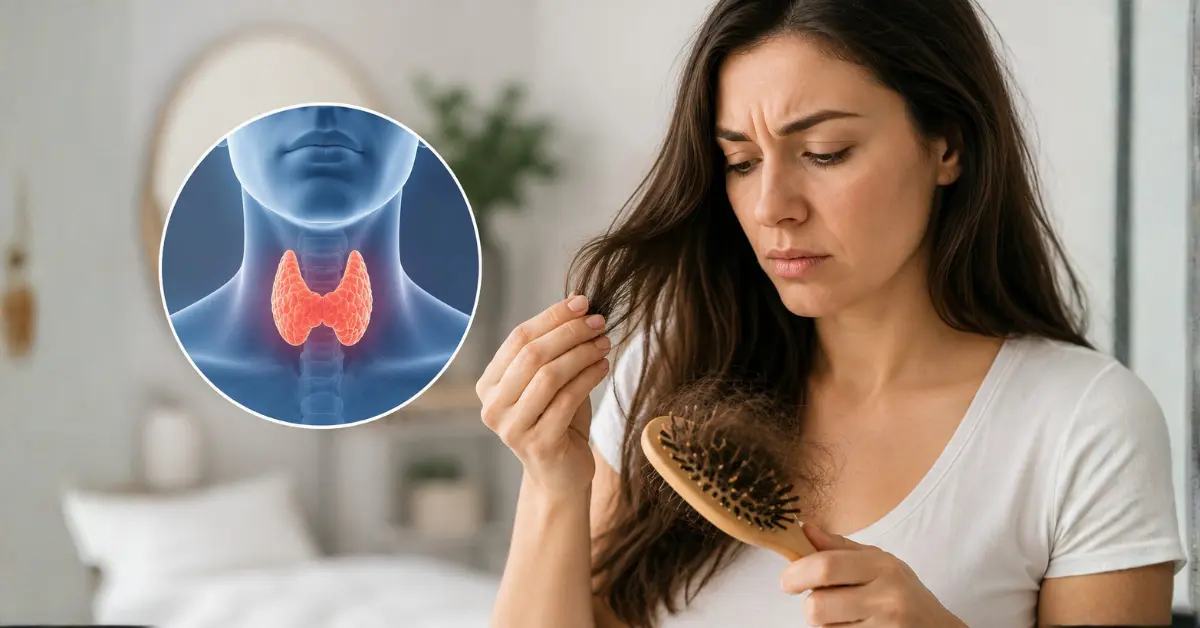
Finding more hair than usual on your pillow, in the shower, or on your hairbrush can be worrying. Hair shedding is common and can happen for many different reasons, but one possible cause that deserves attention is thyroid dysfunction.
The thyroid is a small, butterfly-shaped gland in the neck, but the hormones it produces influence many processes throughout the body. When thyroid hormone levels are too low or too high, changes can occur in the skin, hair, and nails. Some people may notice increased hair shedding, thinning, dryness, or changes in hair texture.
However, hair loss does not automatically mean you have a thyroid problem. Hair shedding has many possible causes, including hereditary hair loss, nutritional deficiencies, stress, illness, hormonal changes, medications, and scalp conditions.
Understanding the possible connection between thyroid health and hair loss can help you decide when it may be worth speaking with a healthcare professional.
What Does the Thyroid Have to Do With Your Hair?
Hair follicles go through a natural cycle of growth, transition, and resting phases. At any given time, most scalp hairs are actively growing while a smaller proportion are in the resting phase.
When the body experiences a significant physiological change, more hair follicles can enter the resting phase at the same time. This may result in increased shedding several weeks or months later.
One common type of temporary diffuse shedding is called telogen effluvium. It can occur after events such as significant illness, fever, childbirth, rapid weight loss, nutritional deficiencies, psychological stress, certain medications, and thyroid disorders.
This delayed timing can make the cause difficult to identify. Someone may experience an illness or hormonal change months before they actually notice increased hair coming out in the shower.
Can an Underactive Thyroid Cause Hair Loss?
An underactive thyroid, medically known as hypothyroidism, occurs when the thyroid does not produce enough thyroid hormone.
Hair changes can be one of the features associated with thyroid dysfunction. Some people may notice that their hair becomes dry, coarse, brittle, or thinner. Increased shedding can also occur.
Other symptoms associated with hypothyroidism can include:
· Fatigue or low energy
· Feeling unusually cold
· Dry skin
· Constipation
· Weight gain
· Difficulty concentrating
· Changes in mood
· Menstrual changes
Not everyone with hypothyroidism will experience all of these symptoms. Importantly, many of these symptoms are also common in other conditions, so they cannot be used to diagnose a thyroid disorder on their own.
Can an Overactive Thyroid Cause Hair Loss Too?
Yes. Hair changes aren’t limited to an underactive thyroid.
Hyperthyroidism occurs when there is excessive thyroid hormone activity. Depending on the cause and severity, people may experience symptoms such as increased heart rate, anxiety, sweating, heat intolerance, difficulty sleeping, and unexplained weight loss. Hair and skin changes can also occur.
This is one reason it is important not to assume that hair loss automatically means the thyroid is underactive.
Both hypothyroidism and hyperthyroidism can affect normal hair and skin function.
What Does Thyroid-Related Hair Loss Look Like?
Hair loss associated with thyroid dysfunction may appear as diffuse thinning, meaning shedding occurs across the scalp rather than producing one clearly defined bald patch.
You might notice:
· More hair collecting in the shower
· Increased hair on your pillow
· More hair coming out while brushing
· A reduction in overall hair density
· Hair becoming dry or brittle
· A widening part
· Slower changes in hair growth or texture
However, these signs are not specific to thyroid disease.
For example, female pattern hair loss can cause gradual thinning around the top and front of the scalp, while telogen effluvium can cause more widespread shedding. Alopecia areata can cause patchy hair loss and is also associated with autoimmune conditions, including thyroid disease.
This is why identifying the pattern of hair loss is an important part of evaluation.
Why Does Hair Sometimes Fall Out Months After a Health Problem?
This is one of the most confusing aspects of hair shedding.
With telogen effluvium, the hair loss may not happen immediately after the event that triggered it. Increased shedding is commonly noticed around 2 to 4 months after a triggering event.
For example, imagine someone experienced a significant illness in January but began noticing heavy hair shedding in April. They may initially assume that their shampoo, hair products, or diet are responsible.
In reality, the earlier illness may have affected the hair growth cycle.
The same principle can apply to thyroid dysfunction, major stress, significant weight loss, childbirth, or nutritional problems.
Should You Get a Thyroid Blood Test for Hair Loss?
If you have persistent or unexplained hair shedding, particularly if you also have symptoms that could indicate thyroid dysfunction, it is reasonable to discuss thyroid testing with your healthcare professional.
A thyroid evaluation commonly includes a TSH test, with additional thyroid hormone testing such as free T4 depending on the clinical situation and initial results.
The appropriate tests depend on your symptoms, medical history, medications, and examination. A healthcare professional can determine what testing is appropriate rather than relying on a single test result.
If you’re looking for a Thyroid blood test in Dubai, consider choosing a healthcare provider that can help interpret the results in the context of your symptoms rather than simply providing a laboratory number.
What If My Thyroid Results Are Normal?
A normal thyroid result does not mean your hair loss is unexplained or that the symptoms aren’t real.
It simply means thyroid dysfunction may not be the cause.
Hair loss has a long list of possible causes. The American Academy of Dermatology notes that hereditary hair loss, thyroid disease, nutritional deficiencies, certain illnesses, medications, and several other conditions can contribute to hair loss.
Depending on your symptoms and medical history, your healthcare professional may consider other possible causes.
These can include:
· Iron deficiency
· Nutritional deficiencies
· Recent illness or fever
· Significant stress
· Rapid weight loss
· Hormonal changes
· Pregnancy or postpartum changes
· Medications
· Female or male pattern hair loss
· Alopecia areata
· Scalp conditions
The goal is to identify the underlying reason rather than assuming every case of hair shedding has the same solution.
What Tests Might Be Considered?
There is no single blood-test panel that is appropriate for every person with hair loss.
Depending on the individual, a healthcare professional may consider thyroid testing along with other investigations when clinically indicated.
For example, iron status may be relevant because iron deficiency is recognized as a potential contributor to diffuse hair shedding. Other tests may be considered based on symptoms, diet, menstrual history, medications, medical conditions, and examination findings.
If your hair loss is significant or persistent, a dermatologist can also examine the scalp and hair pattern to determine whether the problem is shedding, pattern hair loss, alopecia areata, or another condition.
Can Treating a Thyroid Problem Improve Hair Loss?
If thyroid dysfunction is contributing to hair loss, treating the underlying thyroid condition is an important part of management.
However, hair does not necessarily return to normal immediately after thyroid hormone levels improve.
Hair follicles operate on a cycle so that visible improvement can take time. When increased shedding is related to telogen effluvium, removing or treating the underlying trigger can allow the hair cycle to recover.
This is why it is important to be patient and focus on correcting the underlying problem rather than expecting an immediate change in hair density.
What About Hair Loss Support IV Therapy?
People experiencing hair concerns sometimes look for nutritional or hydration treatments as part of their overall wellness routine.
However, IV therapy should not be presented as a replacement for diagnosing thyroid disease or another underlying medical condition.
If a thyroid disorder, iron deficiency, nutritional deficiency, or another medical problem is contributing to hair shedding, that underlying issue should be properly assessed and managed.
For people considering hair loss support IV therapy in Dubai, a responsible healthcare provider should first consider the individual’s medical history and whether there is a clinically appropriate reason for the treatment.
When Should You Speak With a Doctor?
Consider seeking professional advice if your hair shedding:
· Continues for several months
· Is noticeably increasing
· Produces significant thinning
· Occurs together with unexplained weight changes
· Is accompanied by unusual fatigue or temperature sensitivity
· Occurs with menstrual changes
· Appears as bald patches
· Is associated with scalp pain, inflammation, scaling, or other unusual symptoms
Sudden or severe hair loss should also be evaluated rather than self-treated.
The American Academy of Dermatology emphasizes that determining the cause of hair loss is important because treatment depends on the underlying condition.
The Bottom Line
Thyroid problems can affect the hair and may contribute to increased shedding or thinning. Both an underactive and an overactive thyroid can be associated with hair changes.
But hair loss is not a diagnosis of thyroid disease.
If you’re experiencing unexplained shedding, the most useful first step is to look at the bigger picture: your symptoms, medical history, medications, recent illnesses, nutrition, hormonal health, and the pattern of hair loss.
A thyroid blood test may be appropriate in some situations, but it is only one part of understanding why your hair is changing.
Rather than focusing solely on the hair that is falling out, focus on finding out why it is happening. Identifying and addressing an underlying health problem can be a much more meaningful step toward supporting healthy hair in the long term.
Medical References
1. American Academy of Dermatology (AAD). Hair loss: Who gets it and what causes it.
2. American Academy of Dermatology (AAD). Thyroid disease: A checklist of skin, hair, and nail changes.
3. DermNet. Telogen effluvium.
4. DermNet. Diffuse alopecia.
5. DermNet. Skin problems associated with thyroid disease.
6. Bin Dayel S, et al. Is thyroid dysfunction a common cause of telogen effluvium? A retrospective study. Medicine (Baltimore). 2024;103(1):e36803.
7. American Thyroid Association. Clinical Thyroidology for the Public.
Medical disclaimer: This article is for general educational purposes and should not be used to diagnose or treat thyroid disease or hair loss. If you are experiencing persistent or significant hair loss, speak with a qualified healthcare professional for an individualized assessment.
Author
-

Aachal Singh is a DHA-licensed registered nurse in Dubai, currently working with JPR Home Health Care. She brings precision and expertise in blood testing, laboratory procedures, and immunity-focused care, alongside her dedication to patient well-being at home.
She earned her nursing degree from Birat Health College and Research Centre, Biratnagar, Nepal (2023), and has been part of JPR Home Health Care since March 2025. In her role, Aachal conducts a wide range of diagnostic and preventive services, with a strong emphasis on accurate lab testing, early detection, and immune health support.
Her key areas of specialization include:
- Blood sample collection and lab test coordination
- Immunity-boosting therapies and preventive health care
- Post-operative care and recovery monitoring
- Chronic condition management with lab-based tracking
- General patient support at home
By combining technical expertise in diagnostics with compassionate care, Aachal ensures patients receive reliable, safe, and evidence-based services. She consistently follows DHA protocols and international nursing standards, keeping her practice aligned with the latest healthcare guidelines.
DHA License: 06652122-001
🔗 View DHA Profile
