© 2026 All rights reserved |


Straight answers for families arranging DHA-licensed nursing and caregiver support for a parent or spouse living with Alzheimer’s – covering stages, cost, daily behaviour challenges, and how to get started safely at home.
DHA Licensed Nurses | 24/7 Care | Free Home Assessment | Coverage Across Dubai
Caring for a loved one with Alzheimer’s at home is one of the hardest things a family in Dubai will manage, and most of the hardest questions come up late at night or in the middle of a difficult day. This page brings together the 25 questions families ask us most often when arranging home nurses and caregivers in Dubai for someone with Alzheimer’s — from understanding the stages of the disease to managing sundowning, medication, and the decision between hourly and 24-hour elderly care.
JPR Home Health Care is a DHA-licensed provider, and every answer below reflects how our nurses and trained caregivers actually work in Dubai homes. It is written to be read straight through or scanned question by question, and it is not a substitute for a doctor’s diagnosis or care plan — use it to prepare better questions for your loved one’s physician and for our clinical team.
Not sure where to start? A free home assessment tells you exactly what level of care your loved one needs.
Alzheimer’s disease is a progressive brain condition that gradually destroys memory, thinking skills, and the ability to carry out simple daily tasks. It is the most common cause of dementia, and it worsens over time as brain cells are damaged and connections between them break down.
Because it develops gradually, families often notice small changes for months or years — misplacing items, repeating stories, or losing track of appointments — before a clear pattern of decline becomes obvious.
Normal ageing may mean occasionally forgetting a name and recalling it later, or misplacing keys now and then. Alzheimer’s involves memory loss that disrupts daily life: forgetting recently learned information, repeating the same question within minutes, and struggling with familiar tasks like paying bills or following a usual recipe.
Personality and mood changes, confusion about time or place, and withdrawal from usual activities are also more typical of Alzheimer’s than normal ageing, and are worth raising with a physician early.
Most people with Alzheimer’s, including many in the moderate and even advanced stages, can be cared for safely at home in Dubai with the right support in place. A DHA-licensed nurse or trained caregiver manages medication, daily routine, safety, and behavioural changes at home.
Residential or hospital-based care is usually only needed when there are complex medical complications alongside the dementia. See our answer on when hospital or facility care is needed further down this page.
Alzheimer’s is generally described in early, middle, and late stages. In the early stage, care usually means reminders, light supervision, and help staying organised. In the middle stage, support expands to dressing, bathing, meal preparation, and managing behavioural changes such as confusion or agitation.
In the late stage, a person typically needs full assistance with mobility, feeding, and personal care, and often benefits from a skilled nurse for swallowing difficulties, skin care, or if they become bedbound and at risk of pressure sores.
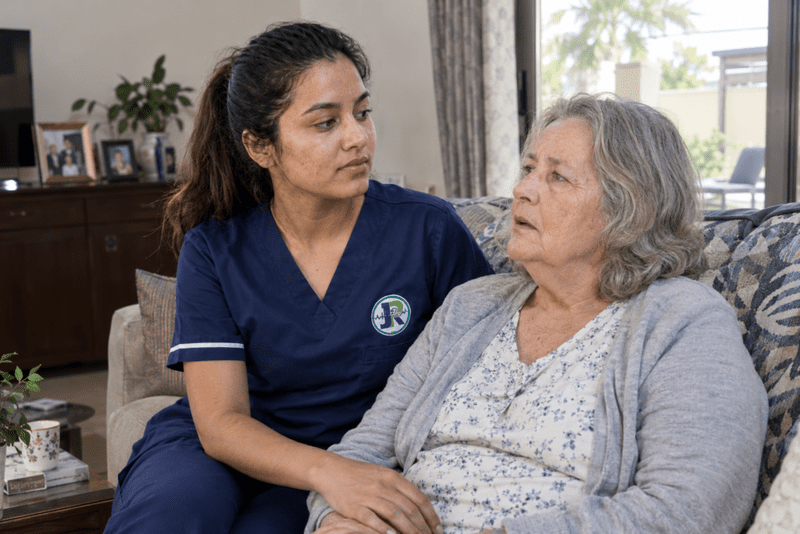
A DHA-licensed nurse manages medication schedules, monitors vital signs, assists with hygiene and mobility, and structures a calm, predictable daily routine — which matters enormously for someone with Alzheimer’s.
They also watch for early signs of infection, pain, or distress that a person with advanced Alzheimer’s may not be able to describe themselves, and communicate any changes to the family and the treating physician. Read more about what a home care nurse does in Dubai.
A caregiver supports daily activities — bathing, dressing, meal preparation, companionship, and supervision — while a licensed nurse additionally handles clinical tasks such as medication administration, wound care, and monitoring underlying health conditions.
Many Alzheimer’s care plans in Dubai combine both: a caregiver for day-to-day support and a nurse for clinical oversight, or a single dual-trained professional for lighter cases. Read our full guide to choosing between a caregiver and a nurse.
Cost depends on whether care is arranged as hourly visits, a live-in arrangement, or full-time skilled nursing, and it changes as the condition progresses and needs increase.
Rather than quote a single figure that may not reflect your loved one’s actual stage, JPR offers a free home assessment and a written quote based on the real care plan needed. See our general home nursing and caregiver rates in Dubai for a starting reference.
Early-stage Alzheimer’s often only needs a few hours of daily support — help with medication reminders, meals, and outings. Middle and late-stage Alzheimer’s, especially where wandering, night-time confusion, or fall risk are present, usually needs 24-hour live-in or shift-based nursing for continuous safety.
A home assessment is the most reliable way to match the arrangement to the actual stage rather than guessing.
Sundowning is a pattern of increased confusion, agitation, or restlessness that appears in the late afternoon or evening, common in the middle and late stages of Alzheimer’s.
Caregivers manage it by keeping a consistent daily routine, reducing evening noise and screen exposure, using a calm and reassuring tone rather than correcting the person, and adjusting indoor lighting gradually as it gets dark instead of an abrupt change.
Caregivers reduce wandering risk by maintaining a predictable schedule, securing doors and balcony access, using door or motion alarms, and making sure the person carries identification with a contact number.
Restlessness is often redirected into a safe activity — a short supervised walk or a simple task — rather than met with confrontation, which usually increases agitation rather than resolving it.
A home nurse organises medications by dose and time, administers them directly where needed, and watches for side effects or missed doses. This matters because many people with Alzheimer’s are also managing other conditions such as diabetes or high blood pressure alongside dementia medication.
Any changes are coordinated directly with the prescribing doctor rather than adjusted informally at home.
As Alzheimer’s progresses, appetite loss, forgetting to eat, and eventually swallowing difficulties become common. Caregivers respond with small, frequent meals, texture-modified food when swallowing is affected, and regular hydration reminders.
Weight and intake are monitored so nutritional decline is caught early rather than discovered after significant weight loss has already occurred.
Short, simple sentences, one instruction at a time, a calm tone, and gentle physical cues such as pointing or a light touch on the hand tend to work better than long explanations.
Caregivers are trained to validate the person’s emotions in the moment rather than correct facts or argue over confusion, which tends to reduce distress on both sides.
Common changes include removing loose rugs and trip hazards, adding grab rails in bathrooms, securing balcony doors, disabling or supervising kitchen appliances, using clear room labels, and placing nightlights along hallways.
Medications, cleaning products, and sharp tools should be locked away or moved out of easy reach as judgement and recognition decline. See related guidance on reducing fall risk for elderly patients at home.
Caregivers follow a consistent, unhurried routine, lay out clothing in the order it will be worn, and offer simple either-or choices instead of open-ended questions that can cause confusion.
Dignity and privacy are maintained throughout, and the approach is adjusted as the person’s physical and cognitive abilities change over time.
Respite care is short-term or occasional professional cover — a few hours, an overnight, or a longer stretch — that gives a family caregiver a genuine break from constant supervision.
It reduces caregiver burnout, which is one of the most common reasons families reach out to us, and it lets JPR’s nursing team step in during travel, illness, or simply when rest is needed.
Caregivers are trained to look for underlying triggers first — pain, hunger, overstimulation, fear, or an unmet need the person cannot express — rather than treating the behaviour as the problem itself.
The typical response is to stay calm, avoid arguing, give physical space, and redirect attention to a familiar object or activity instead of forcing a task at that moment.
Yes. JPR’s nurses guide families on daily routines, communication techniques, medication safety, and warning signs that need medical attention, so care stays consistent whether the nurse or a family member is present.
Families also benefit from the reassurance of a home nurse who provides genuine companionship, not just clinical task completion.
Hospital or facility-based care may be needed for acute medical crises, severe uncontrolled behaviour that risks the person’s or others’ safety, or complex conditions requiring round-the-clock hospital-grade equipment.
An example is when a patient needs continuous ventilator support beyond what a standard home setup can safely manage — though even then, many families successfully transition back to supported home care once stabilised.
Coverage varies significantly by insurance provider and policy, and home nursing is not always included by default in standard health plans.
JPR’s team can help families check documentation requirements and coordinate with insurers where a policy does include home nursing benefits, alongside straightforward private-pay options for families whose plans do not.
JPR’s nurses are DHA-licensed, and caregivers receive specific training in dementia care techniques — including safe handling, fall prevention, behaviour management, and communication approaches suited to Alzheimer’s.
All care is supervised by JPR’s clinical team, so families always have a licensed point of contact for questions about their loved one’s condition.
Alzheimer’s is one specific type of dementia, and the most common one. Other types, such as vascular dementia or Lewy body dementia, have different underlying causes and can present with different symptom patterns, such as more sudden step-wise decline or early movement difficulties.
In practice, day-to-day home care needs overlap significantly across dementia types, which is why JPR’s caregivers are trained broadly in dementia care rather than only Alzheimer’s-specific protocols.
JPR nurses are trained to recognise emergency signs such as falls, sudden confusion beyond the person’s baseline, breathing difficulty, or choking during meals.
The response includes immediate first aid, contacting emergency services when required, and notifying the family and coordinating physician right away, with a clear record of what happened for the doctor’s follow-up.
JPR typically arranges an initial home assessment and matches a suitable nurse or caregiver within a short timeframe of first contact, with urgent cases prioritised wherever possible.
Reaching out early, even before a crisis, generally means a smoother match between the right professional and your loved one’s specific personality and needs.
Confirm the provider is DHA-licensed, ask specifically what dementia training their caregivers receive, and check availability for both hourly and 24-hour or live-in arrangements since needs change over time.
Most importantly, insist on a home assessment before agreeing to a package, so the care plan is built around the person’s actual stage and behaviour rather than a generic offering. Book a free assessment with JPR to get a clear, written recommendation.
Speak with our clinical team about a care plan for your loved one — no obligation, just clarity.
Follow overview of JPR’s home nursing service
General senior home care services
Follow overview of Blood Test at home service
Follow overview of Physiotherapy at home service
Follow overview of Baby Care service
Follow overview of JPR’s home nursing service
This page is provided for general information and is not a substitute for a medical diagnosis or professional care plan. Please consult a qualified physician for diagnosis and treatment decisions, and speak with JPR’s clinical team to arrange an assessment suited to your loved one’s specific condition.
© 2026 All rights reserved |