
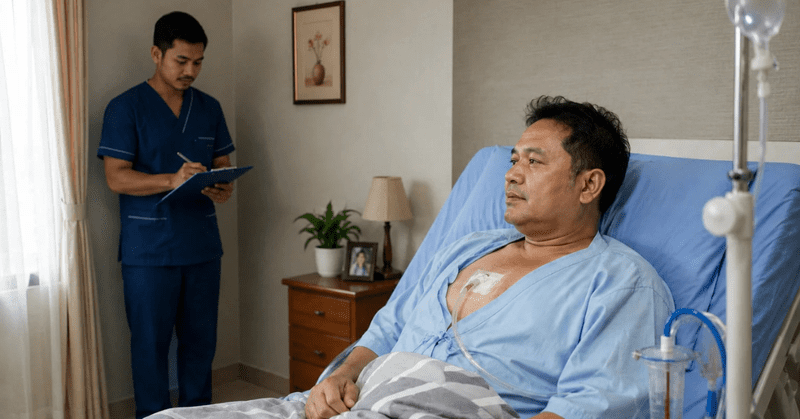
Coming home after chest surgery is often a relief, but it also marks the beginning of an important recovery period. While family members are eager to help, caring for someone with a chest tube requires specialized medical knowledge and constant observation. A chest tube is a medical device placed between the lungs and chest wall to remove air, blood, or other fluids that can prevent the lungs from expanding properly.
This is why many patients recovering from chest surgery benefit from having a licensed nurse at home. Professional nursing care helps monitor recovery, identify early warning signs, and ensure the chest drainage system continues to function as intended. Having a skilled nurse can also give family members confidence, knowing their loved one is receiving appropriate clinical care during recovery.
Purpose of a Chest Tube
To understand why nursing care is so important, it helps to know what a chest tube does.
The lungs are surrounded by two thin protective membranes called the pleura. Between these layers is a small space containing a tiny amount of fluid that allows the lungs to move smoothly during breathing. This space normally maintains negative pressure, allowing the lungs to expand fully every time you inhale.
After chest surgery or certain medical conditions, air, blood, or fluid may collect in this space. When this happens, the pressure changes and the lung may partially or completely collapse, making breathing difficult.
A chest tube is inserted into this space to drain unwanted air or fluid, allowing the lung to expand normally again.
Why Might Someone Need a Chest Tube?
Chest tubes are used for several medical conditions, including:
- Recovery after heart or chest surgery
- Pneumothorax (collapsed lung caused by trapped air)
- Pleural effusion (fluid around the lungs)
- Hemothorax (blood collecting in the chest cavity)
- Empyema (infection causing pus around the lungs)
- Chylothorax (lymphatic fluid leaking into the chest)
Patients recovering from cardiac surgery may also have mediastinal chest tubes that remove excess blood or fluid around the heart, helping reduce complications during recovery.
Recovery Doesn’t End After Leaving the Hospital
Although the surgery may be over, recovery continues at home. Patients with chest tubes require ongoing monitoring because changes can happen quickly.
A licensed nurse understands how chest drainage systems work and can recognize subtle signs that something isn’t progressing normally. Early identification of potential complications allows medical attention to be sought promptly, helping reduce risks.
Without professional observation, important warning signs may go unnoticed until they become more serious.
Monitoring the Chest Drainage System
One of the nurse’s primary responsibilities is ensuring the chest drainage system functions properly.
The drainage system should remain below chest level so gravity allows fluid to drain correctly. The tubing must stay free from kinks, twists, or blockages that could interfere with drainage.
A licensed nurse routinely checks:
- Tubing connections
- Drainage chamber
- Water seal chamber
- Suction chamber (when applicable)
- Overall function of the drainage system
These regular assessments help ensure the system continues working safely throughout recovery.
Different Drainage Systems
Hospitals commonly use wet suction and dry suction drainage systems.
Wet suction systems regulate suction using a water chamber. Gentle bubbling is expected and indicates the system is functioning correctly.
Dry suction systems use a mechanical regulator rather than water. These systems eliminate water evaporation while allowing prescribed suction levels to be maintained.
Because each system functions differently, patients and family members may not always know what is considered normal. A licensed nurse understands these differences and can assess the equipment appropriately.
Monitoring Drainage Carefully
The drainage chamber provides valuable information about the patient’s recovery.
A nurse carefully observes:
- The amount of drainage
- The color of drainage
- Changes in drainage patterns
- Sudden increases or decreases
Accurate recording of drainage is important because healthcare providers often use this information when deciding how recovery is progressing.
Watching for Changes in the Water Seal Chamber
The water seal chamber helps prevent outside air from entering the chest while allowing trapped air to escape.
Small fluctuations in the water level are generally expected as the patient breathes. However, if movement suddenly stops, it may indicate that the lung has fully expanded or that the tubing has become obstructed.
Similarly, continuous bubbling in the air leak monitor may indicate an air leak that requires further assessment.
Recognizing the difference between expected findings and abnormal changes requires clinical training, making professional nursing care especially valuable.
Monitoring the Patient’s Breathing
The chest drainage system is only one part of recovery. Equally important is monitoring the patient’s overall respiratory status.
A licensed nurse regularly evaluates:
- Breathing rate
- Oxygen levels, if prescribed
- Lung sounds
- Ease of breathing
- Chest movement
- Patient comfort
The nurse also watches for signs of increasing respiratory distress, ensuring changes are identified as early as possible.
Caring for the Chest Tube Insertion Site
Preventing infection is another important aspect of post-surgical care.
The insertion site is routinely inspected for:
- Redness
- Swelling
- Drainage
- Bleeding
- Signs of infection
The nurse also checks for swelling beneath the skin that may indicate air has collected in the tissues, a condition that requires prompt medical evaluation.
Keeping the insertion site clean and monitoring healing supports a safer recovery.
Supporting Lung Expansion
Recovery after chest surgery also involves encouraging healthy lung function.
Patients are often encouraged to:
- Perform deep breathing exercises
- Cough effectively
- Change positions regularly
- Stay as active as advised by their healthcare provider
These simple activities help improve lung expansion and assist in clearing secretions while reducing the risk of complications associated with prolonged immobility.
A nurse provides guidance, encouragement, and monitoring during these exercises while ensuring they are performed safely.
Being Prepared for Unexpected Situations
Although complications are uncommon, emergencies can occur.
A chest tube may accidentally become dislodged or the drainage system could become damaged.
A licensed nurse knows the immediate steps required to protect the patient while arranging urgent medical assistance. Their training allows them to remain calm and respond appropriately during unexpected situations.
Having professional support at home provides an additional layer of safety during the recovery process.
Preparing for Chest Tube Removal
When the healthcare team determines the chest tube is no longer needed, it is usually removed by a physician or another appropriately trained clinician.
A nurse helps prepare the patient by explaining the procedure, providing reassurance, assisting with positioning, and monitoring the patient afterward.
Following removal, careful observation continues to ensure breathing remains stable and recovery progresses normally.
Peace of Mind for the Entire Family
Recovering from chest surgery can feel overwhelming, not only for the patient but also for family members providing care.
Many relatives worry about accidentally disturbing the chest tube, missing signs of complications, or responding incorrectly if something changes.
A licensed nurse eases these concerns by providing professional assessments, educating family caregivers, answering questions, and coordinating with the patient’s healthcare team whenever necessary.
Knowing that an experienced healthcare professional is overseeing recovery allows families to focus on supporting their loved one emotionally rather than worrying about complex medical care.
Recovery after chest surgery requires more than rest. Patients with chest tubes need careful observation, ongoing respiratory assessment, proper management of the drainage system, and early recognition of potential complications.
A licensed nurse at home brings the clinical expertise needed to support recovery safely while helping patients regain confidence during the healing process. Professional nursing care also offers reassurance to families, ensuring that both the patient and their loved ones receive the guidance and support needed throughout recovery.
With attentive monitoring and expert care, patients can recover more comfortably while reducing the risks associated with chest tube management at home.
Blood tests are one of the most powerful tools in preventive healthcare. They reveal what the body cannot say out loud: an iron level quietly dropping, a thyroid that has been struggling for months, a blood sugar creeping upward long before symptoms appear. Most people know they should get tested regularly. Far fewer actually do, often because the process feels inconvenient, clinical or intimidating.
Home blood collection changes that entirely. A trained nurse comes to you, draws the sample in a calm and familiar setting, and ensures it is handled and dispatched correctly for accurate results. There is no waiting room, no fasting drive across the city, no disruption to your day. For busy professionals, elderly patients, new mothers, or anyone managing a chronic condition, having a skilled nurse come to you is not a luxury. It is simply the smarter way to stay on top of your health.
The accuracy of a blood test depends as much on the collection process as on the laboratory. A poorly drawn sample, incorrect tube handling, or a missed fasting window can compromise results entirely. This is why the nurse collecting your blood matters. Proper technique, timing, labelling, and cold-chain handling from your home to the lab are all part of what a professional home visit provides.
Why does the nurse collecting your blood sample matter so much?
Blood collection looks straightforward from the outside. It is not. Vein selection, needle angle, draw order, tube inversion, temperature-sensitive handling each step affects the quality of your result. A nurse who does this daily, who understands which tests require fasting, which tubes must not be shaken, and which samples need to reach the lab within a specific time window, is protecting the integrity of every result you receive.
Beyond the technical side, a good home nurse makes the experience genuinely comfortable. Patients who are anxious about needles, elderly patients with difficult veins, or children requiring a draw all need someone with both skill and patience. Getting an accurate result starts well before the needle enters the vein.
Author
-

Mina Kumari BK is a DHA-licensed Registered Nurse at JPR Home Health Care, Dubai, with a strong focus on IV therapy and wellness-based nursing care. She specializes in delivering safe, effective IV drip treatments at home, supporting hydration, energy, and overall patient recovery.
Originally from Nepal and a graduate of Nobel College, Pokhara (2024), Mina brings hands-on experience in IV cannulation, infusion monitoring, and patient care. Since joining JPR, she has become a reliable choice for clients seeking professional in-home IV therapy with comfort and precision.
Her core competencies include:
Administration of IV drips for hydration, energy, and wellness support
Skilled IV cannulation and safe infusion monitoring
Patient assessment and vital signs monitoring before and during IV therapy
Post-treatment care and observation to ensure patient safety
General nursing care and recovery support in home settings
Mina is known for her gentle technique, attention to detail, and commitment to patient comfort, making her a trusted nurse for IV therapy services in Dubai.
DHA License
License Number: 64192972-001
