© 2026 All rights reserved |

Blood tests are one of the most powerful tools in preventive healthcare. They reveal what the body cannot say out loud: an iron level quietly dropping, a thyroid that has been struggling for months, a blood sugar creeping upward long before symptoms appear. Most people know they should get tested regularly. Far fewer actually do, often because the process feels inconvenient, clinical or intimidating.
Home blood collection changes that entirely. A trained nurse comes to you, draws the sample in a calm and familiar setting, and ensures it is handled and dispatched correctly for accurate results. There is no waiting room, no fasting drive across the city, no disruption to your day. For busy professionals, elderly patients, new mothers, or anyone managing a chronic condition, having a skilled nurse come to you is not a luxury. It is simply the smarter way to stay on top of your health.
The accuracy of a blood test depends as much on the collection process as on the laboratory. A poorly drawn sample, incorrect tube handling, or a missed fasting window can compromise results entirely. This is why the nurse collecting your blood matters. Proper technique, timing, labelling, and cold-chain handling from your home to the lab are all part of what a professional home visit provides.
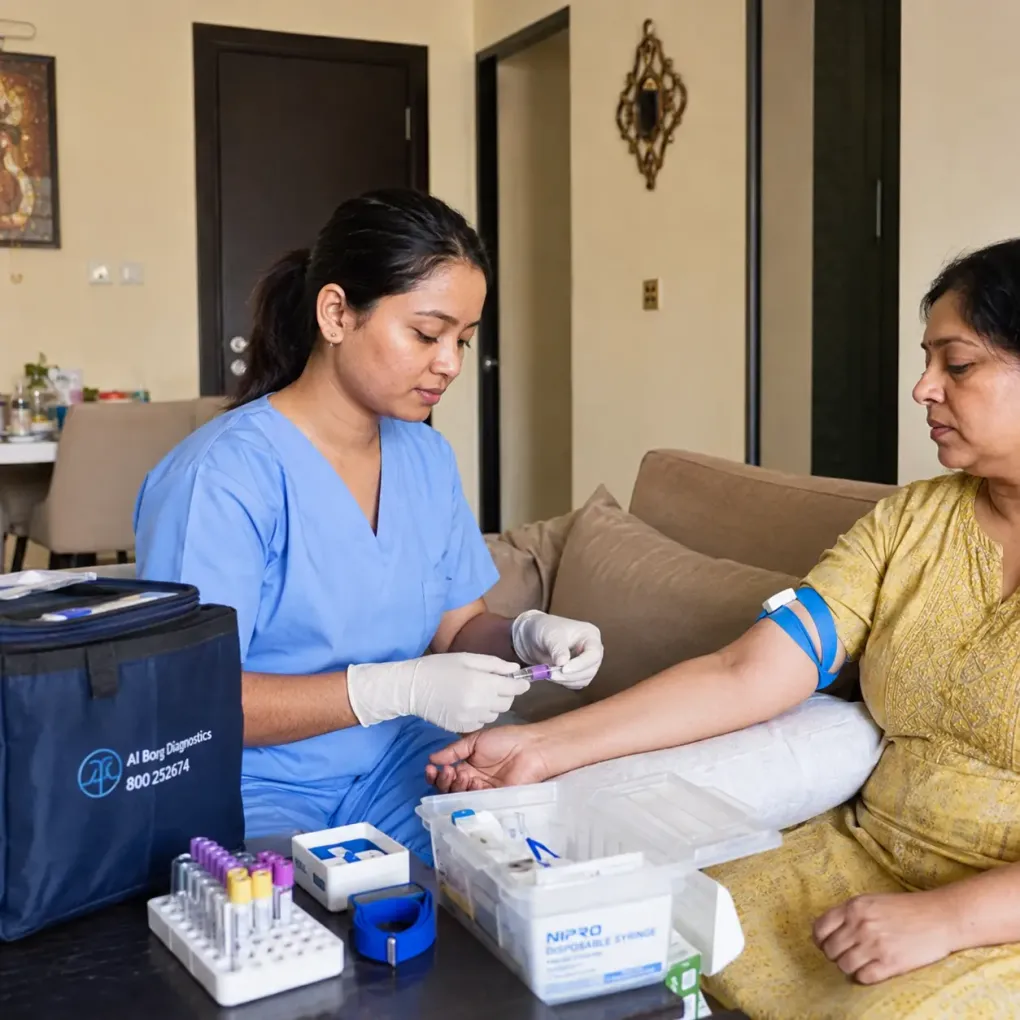
Blood collection looks straightforward from the outside. It is not. Vein selection, needle angle, draw order, tube inversion, temperature-sensitive handling each step affects the quality of your result. A nurse who does this daily, who understands which tests require fasting, which tubes must not be shaken, and which samples need to reach the lab within a specific time window, is protecting the integrity of every result you receive.
Beyond the technical side, a good home nurse makes the experience genuinely comfortable. Patients who are anxious about needles, elderly patients with difficult veins, or children requiring a draw all need someone with both skill and patience. Getting an accurate result starts well before the needle enters the vein.
DHA-Licensed Home Care Nurse · Blood Collection Specialist
2+ years of home blood collection experience across Dubai

Preparation the night before makes a significant difference to result accuracy. I always advise patients to stop eating at least eight to ten hours before the scheduled visit. Water is fine throughout, and staying hydrated actually makes vein access easier for me. Avoid alcohol the night before as it directly affects liver markers and triglycerides. Keep your medications as normal unless your doctor has specified otherwise; stopping them without guidance can be more disruptive than the test itself. Lay out any previous reports you have so I can cross-reference when needed. A light activity evening, good sleep, and no strenuous exercise the morning of the draw all contribute to a clean baseline. The more settled your body is when I arrive, the more your results will reflect your true health picture rather than a temporary deviation.
Fasting is required for tests where food directly alters the values being measured. Fasting Blood Sugar, HbA1c for a fasting baseline, Lipid Profile, Triglycerides, and most Liver Function panels all need a clean overnight fast of eight to ten hours. Kidney Function Tests and some hormonal panels like Testosterone are ideally done fasting as well. Tests that do not require fasting include CBC, Thyroid Profile, Vitamin D, Vitamin B12, Calcium, and cancer markers like AFP, CEA, and PSA. Cortisol is time-sensitive rather than fasting-sensitive; it should be collected between 7am and 9am when levels are naturally at their peak. When you book a visit with me I always confirm which tests are on your panel and advise you precisely so there is no confusion on the morning of the draw.
Water is not only safe before a blood draw it is actively encouraged. Staying well hydrated keeps your veins plump and accessible, which makes the draw faster, cleaner, and more comfortable for you. Dehydration concentrates the blood and can falsely elevate certain values, including haematocrit, haemoglobin, and some electrolyte readings. What must be avoided is anything other than plain water, no coffee, no tea, no juice, no flavoured water, and certainly no milk. Even black coffee without sugar affects cortisol and insulin levels and can raise blood pressure enough to influence certain panels. I remind every patient before a fasting visit: water freely, nothing else. That one simple rule protects the accuracy of your results and makes my job of accessing the vein considerably easier, particularly in the early morning when patients are naturally slightly dehydrated.
In most cases, yes. Stopping regular medications before a blood test is rarely necessary and can sometimes be more disruptive than the test itself. Blood pressure medications, thyroid replacement therapy, diabetes medications, and most supplements can generally be taken as normal. The exception is if your doctor has specifically requested a trough level meaning they want to measure the medication concentration in your blood at its lowest point, just before your next dose. Some lipid-lowering medications are also sometimes paused before a Lipid Profile if the treating physician wants a true baseline. My approach is always to confirm with the patient and, where there is any doubt, to check with the prescribing doctor before the visit. I never assume. The goal is that your results reflect your actual clinical status, and medication timing is part of achieving that accurately.
I never block the door and say no directly. That creates immediate panic and makes the urge to leave stronger. I walk with them instead. I fall into step beside them and ask, in a relaxed way, where they are heading. There is almost always a purpose behind it, something from their past that feels urgent and real to them. I cared for a patient who tried to leave every afternoon at 3pm because her mind had returned to the years she used to collect her children from school. Her family was distressed each time. I worked with them to create a small ritual at that exact time each day. We would look at photos of her grown children together and have a cup of tea. The door attempts stopped within two weeks. I find the need underneath the behaviour and try to meet it another way.
The Full Body Check is the most comprehensive routine panel I collect at home. It covers CBC to assess your blood cells and check for anaemia or infection, Fasting Blood Sugar and HbA1c for diabetes screening, Lipid Profile for cardiovascular risk, Kidney Function and Liver Function to assess organ health, Thyroid Profile since thyroid dysfunction is extremely common and frequently undetected, and Vitamin D and B12 which are deficient in a large proportion of people in Dubai due to indoor lifestyles and dietary patterns. I recommend this panel once a year for any adult over thirty, and more frequently for anyone with a chronic condition, a family history of metabolic disease, or persistent fatigue and low energy. It gives both you and your doctor a complete clinical snapshot to work from rather than chasing individual symptoms one test at a time.
The Basic Diabetic Test gives you an entry-level picture typically of a Fasting Blood Sugar alongside a CBC and foundational organ markers. It is appropriate for an initial screen or an annual check in someone with no existing diagnosis. The full Diabetic Monitoring package goes considerably deeper. It adds HbA1c, which reflects your average blood sugar over the previous three months and is the true measure of glycaemic control. It includes Urine Microalbumin, which detects early kidney involvement before conventional kidney markers show any change. It also includes Lipid Profile, Thyroid, and Vitamins because diabetes frequently coexists with thyroid dysfunction and micronutrient deficiencies that directly affect management. For anyone already diagnosed with Type 2 diabetes or prediabetes, or with a strong family history, the full monitoring package is what I recommend. The extra markers are not extras; they are part of managing the condition properly.
A standard Lipid Profile tells you your total cholesterol, LDL, HDL, and triglycerides. That is useful but incomplete for someone who wants a true picture of cardiovascular risk. The Heart and Cardiovascular Risk package goes significantly further. Lipoprotein(a) is a genetically determined risk factor that a normal Lipid Profile completely misses elevated levels substantially increasing heart attack risk regardless of standard cholesterol values. hsCRP is a sensitive inflammation marker that predicts arterial disease well before conventional markers. Apolipoprotein-B reflects the number of atherogenic particles in the blood, which is often more predictive than LDL alone. Homocysteine elevation is an independent cardiovascular risk factor linked to clotting and arterial damage. I recommend this panel for anyone with a family history of early heart disease, anyone whose standard lipid results seem inconsistent with their risk profile, or anyone who wants a thorough preventive baseline rather than a superficial one.
The Women’s Hormonal Health package combines a CBC and metabolic foundation with a targeted hormonal panel: LH, FSH, Prolactin, Estradiol, and AMH. Together these give a detailed picture of ovarian function, reproductive hormone balance, and fertility reserve. LH and FSH assess the signalling between the brain and the ovaries. Estradiol reflects oestrogen production and cycle regulation. Prolactin elevation can cause irregular cycles and is sometimes linked to a pituitary issue. AMH is the most reliable marker of ovarian reserve and is particularly relevant for women considering family planning or monitoring the approach of perimenopause. I recommend starting this panel from the mid-twenties if there are concerns about cycle regularity, fertility, or hormonal symptoms. For women in their late thirties and beyond, it becomes an important part of understanding perimenopause. I always advise collecting on the second or third day of the cycle unless otherwise guided by a gynaecologist.
Cancer marker tests measure proteins or substances that can be elevated in the presence of certain cancers. The women’s panel covers AFP, CEA, Beta HCG, CA19-9, CA125, and CA15-3. The men’s panel adds PSA and Free PSA. These are legitimate tools for monitoring known conditions and for certain high-risk individuals. However, I am always honest with patients about their limitations as standalone screening tests. A normal result does not rule out cancer, and an elevated result does not confirm it many benign conditions raise these markers. PSA, for instance, rises with prostate inflammation and benign enlargement, not only cancer. These panels are most valuable when ordered by a doctor who can interpret them in the context of your full clinical picture, not as an isolated home screen. For the general healthy population, I recommend discussing with your physician which markers are appropriate for your age, family history, and risk factors before requesting them.
When I arrive I first confirm your identity and the test panel is booked. I check your fasting status if required and ask a few brief questions about current medications and any recent illness that might affect interpretation. I then set up my collection area on a clean surface. I bring everything I need including sterile equipment, labelled tubes, a sharps container, and a cool bag for sample transport. I ask you to sit or lie comfortably and I select a suitable vein, usually in the antecubital fossa at the inner elbow. The draw itself takes under two minutes for most panels. I label every tube immediately at your side, invert each one correctly, and place them in the cool bag. I apply gentle pressure and a small plaster. Before I leave I confirm the lab dispatch timeline and explain when and how you will receive your results. The entire visit is typically twenty to thirty minutes.
Sample integrity between collection and the lab is something I take seriously because it directly affects your results. I use a calibrated cool bag that maintains the correct temperature range most samples need to be kept between two and eight degrees Celsius, particularly hormone panels and certain enzyme tests which degrade rapidly at room temperature. Each tube is labelled with your name, date of birth, collection time, and test code immediately after the draw, before anything else happens. I never pre-label tubes. Tubes that require specific handling EDTA for CBC, SST for biochemistry, citrate for coagulation are each managed correctly. I dispatch samples to the partner laboratory within the required window, which for most tests is four hours from collection. For time-sensitive samples like cortisol I coordinate the booking time specifically to ensure same-morning dispatch. Your result is only as reliable as the chain of handling that precedes it.
Difficult veins are something I encounter regularly, particularly in elderly patients, patients who are chronically dehydrated, or those who have had frequent previous draws. My first step is always hydration. I ask patients with known difficult veins to drink an extra litre of water the evening before and another glass first thing in the morning. Warmth helps considerably; I apply a warm compress to the arm for three to five minutes before attempting access, which dilates the vein and makes it more prominent. I take my time palpating before choosing a site, and I never rush the decision. I am comfortable working with forearm veins, hand veins, and in some cases the wrist. I use the smallest gauge needle appropriate for the tube volume required to minimise discomfort. If a first attempt is unsuccessful I pause, reassess, and try a different site calmly. I do not attempt more than twice without discussion.
Absolutely, and this is one of the clearest advantages of home collection. I regularly visit patients who are bedridden, wheelchair-bound, or recovering from surgery. Positioning is adapted entirely to the patient’s situation. For a fully bedridden patient I work with the arm resting alongside the body on the mattress surface, which is often a more stable and comfortable position than a standard chair draw. I bring a small firm pillow to support the arm at the correct angle. For patients with stroke-related weakness I always draw from the unaffected side. For those with lymphoedema I avoid the affected limb entirely and discuss alternatives with the treating team if both arms are involved. The clinical requirements do not change because the setting is a bedroom rather than a clinic. I apply the same technique, the same labelling protocol, and the same handling standards regardless of where the patient is when I collect.
As soon as the draw is complete and I have applied a small plaster, the patient is free to eat immediately. For fasting tests I always encourage patients to have a light meal ready with protein and slow-release carbohydrates rather than a large sugary breakfast, which can cause a reactive dip after the fast. Gentle activity can resume straight away. I ask patients to avoid heavy lifting or strenuous exercise with the draw arm for two to three hours, not because of any clinical risk but simply to avoid bruising at the puncture site. Driving is completely fine. If a patient feels slightly lightheaded after the draw which occasionally happens, particularly in fasting patients I ask them to remain seated, offer water, and wait until the feeling passes before standing. It resolves quickly in almost every case. There are no lasting restrictions after a routine blood draw.
I always make myself available to walk a patient through their results once they come in. Laboratory reports can look alarming if you do not know what you are reading rows of numbers, reference ranges, flags for high and low values. I explain what each marker measures in plain language, what the flagged values mean in the context of the full panel, and which findings need to be followed up with a doctor promptly versus which are minor variations that require only lifestyle attention. What I am careful not to do is diagnose or prescribe. My role is to translate clinical information into something the patient can act on. I help them prepare the right questions for their physician and identify which findings are the priority conversation. A result sitting in an inbox unread or misunderstood helps no one. Understanding it is the first step toward doing something about it.
Vitamin D deficiency is genuinely widespread in Dubai. I would say it is the single most common abnormal finding I see across all age groups, including people who spend time outdoors. The reason is that the intense UV index drives most people indoors during the hottest months, and cultural dress for many residents means skin exposure is limited even when outdoors. The body produces Vitamin D through skin exposure to UVB rays, and that mechanism is largely bypassed here for much of the year. Low Vitamin D affects bone density, immune function, muscle strength, mood, and energy levels. Severely deficient patients often describe persistent fatigue and low mood that has been attributed to stress or lifestyle but is in fact a correctable deficiency. Supplementation under guidance corrects it reliably. I always include Vitamin D in panels for patients with fatigue, joint aches, or frequent infections regardless of which package they have booked.
A CBC showing anaemia typically a low haemoglobin, reduced red cell count, and low haematocrit is always worth investigating properly rather than simply supplementing iron and hoping it resolves. The most common cause I encounter in Dubai is iron deficiency anemia, particularly in women of reproductive age with heavy menstrual cycles and in individuals with low dietary iron intake. I also see B12 and folate deficiency anemia, especially in long-term vegetarians and vegans. Anaemia can also be the presenting sign of a chronic condition kidney disease, inflammatory illness, or thyroid dysfunction so the full picture matters. My immediate guidance is always to share the result with a physician promptly, avoid self-prescribing high-dose iron without knowing the cause, and if iron deficiency is confirmed, add an Iron Profile to identify whether stores are truly depleted. Treatment is straightforward once the cause is clear.
The Thyroid Profile measures TSH, the pituitary signal to the thyroid, alongside Free T3 and Free T4, the active hormones the thyroid produces. An elevated TSH with low T4 suggests the thyroid is underperforming hypothyroidism and the symptoms are often fatigue, weight gain, cold sensitivity, hair thinning, and low mood. A suppressed TSH with elevated T3 and T4 suggests overactivity hyperthyroidism which presents with palpitations, heat intolerance, weight loss, and anxiety. Subclinical abnormalities, where TSH is slightly off but the active hormones are still normal, are common and often require monitoring rather than immediate treatment. The most important next step is always a physician review with the full panel in hand. Thyroid conditions are very manageable once diagnosed. I encourage patients not to panic at an abnormal thyroid result. It is one of the most treatable findings in routine blood work.
For a healthy adult in their twenties with no family history of chronic disease and no symptoms, an annual full panel is generally sufficient. It establishes a personal baseline and catches slow-developing changes before they become clinical problems. From the thirties onward, particularly for anyone with a sedentary lifestyle, a high-stress job, or a family history of diabetes, thyroid disease, or cardiovascular illness, I recommend increasing to twice yearly. By the forties and beyond, hormonal panels become relevant alongside the metabolic markers for women this includes AMH and the reproductive hormones, and for men the testosterone and PSA panel from forty onwards. Patients managing an active chronic condition like diabetes or hypertension often need quarterly monitoring of specific markers. My general approach is to look at the person in front of me, their age, their lifestyle, their family history, their last results and recommend a frequency that fits them, not a generic schedule.
The Immunity and Nutrition package combines a CBC with a Vitamin Package, Iron Profile, Calcium, and Zinc. Together these markers paint a detailed picture of nutritional status and immune foundation. The CBC tells me whether white cells, red cells, and platelets are all performing as they should. Iron Profile goes beyond simple ferritin to measure serum iron, transferrin, and saturation, giving a complete picture of iron stores and transport. Calcium supports nerve and muscle function and is particularly relevant for patients with bone health concerns or those on certain medications. Zinc is a frequently overlooked micronutrient that plays a direct role in immune defence, wound healing, and skin integrity and its deficiency is common, particularly in patients with restricted diets or frequent illness. This panel is particularly valuable for patients who experience frequent infections, slow recovery, persistent fatigue, or poor wound healing, and for those following restrictive or plant-based diets.
The Men’s Hormonal Panel measures Total Testosterone, Free Testosterone, LH, FSH, and Prolactin. Total testosterone gives the overall level, but free testosterone the biologically active fraction is often the more clinically relevant number since a significant proportion can be bound to proteins and unavailable to tissues. LH and FSH are the pituitary signals that drive testosterone production; if these are abnormal it tells us whether the issue originates in the testes or the brain. Prolactin elevation in men can suppress testosterone and cause fatigue, reduced libido, and mood changes. I recommend men start checking testosterone from around thirty-five, earlier if there are symptoms of low energy, reduced muscle mass, mood changes, reduced libido, or difficulty maintaining weight. These symptoms are often attributed to stress or age when they are in fact a measurable and addressable hormonal shift. Awareness and early testing make a significant difference.
This is one of the situations where home collection adds the most value, and it is a scenario I manage regularly. Elderly patients with multiple conditions are often seeing a cardiologist, an endocrinologist, a nephrologist, and a general physician simultaneously, and each specialist may have ordered different tests at different intervals. I work with the family to consolidate the testing schedule wherever possible so the patient is not being drawn from multiple times in a short period. I coordinate with each specialist’s requirements, ensure fasting and timing protocols are met for each panel simultaneously where possible, and prepare a clear dispatch summary so each set of results reaches the correct physician. For patients on anticoagulants or with complex vascular access I liaise with the treating team before the visit. The goal is to reduce the burden on the patient and their family while ensuring every specialist receives the accurate, timely information they need.
hsCRP stands for high-sensitivity C-Reactive Protein. CRP is a protein the liver produces in response to inflammation anywhere in the body. The standard CRP test is designed to detect acute inflammation infection, injury, and a flare of inflammatory disease. The high-sensitivity version, hsCRP, detects the low-grade chronic inflammation that sits inside arterial walls long before a clinical event occurs. Chronic low-level arterial inflammation is now understood to be a central driver of atherosclerosis and cardiovascular events, and hsCRP is one of the best blood-based measures of that process. A result below one milligram per litre is low risk. Between one and three is moderate. Above three is elevated risk and warrants discussion with a cardiologist. I include it in the cardiovascular panel specifically because it can identify risk in patients whose standard Lipid Profile looks acceptable; those are often the patients who are most surprised by a cardiac event and most benefit from early intervention.
Post-operative home blood collection is one of the most practical applications of what I do. After discharge, patients are often weak, in discomfort, and in no position to travel to a clinic for follow-up testing. I typically collect a CBC to monitor for post-operative anaemia, infection, or platelet changes, a Basic Metabolic Panel or Kidney Function Test to check electrolyte balance and renal response to anaesthesia and fluid management, and a CRP if there is any concern about wound healing or infection. For patients on post-operative anticoagulants like warfarin, regular INR checks are needed and home collection removes the significant burden of repeated clinic visits. The earliest I would typically draw post-operatively at home is forty-eight hours after discharge, once the patient is stable and positioned safely. I confirm the specific panel with the operating team before the visit and report any concerning results directly and promptly.
These answers reflect Aachal Singh’s personal experience and are intended for educational guidance only. They do not replace the advice, diagnosis, or interpretation of your physician, pathologist, or healthcare provider regarding your blood test results.
© 2026 All rights reserved |