
© 2026 All rights reserved |


Alzheimer’s is a progressive brain condition that gradually takes away memory, reasoning, language and the ability to manage everyday tasks. It does not happen overnight. It unfolds slowly, and families often notice something is wrong long before a diagnosis is made. A parent who forgets familiar faces, gets confused in their own home, loses track of time or becomes a different person by evening. These are not signs of old age. They are signs that the brain is changing in ways that require real, specialised care.
For most families in Dubai, the instinct is to keep their elderly parent at home. That instinct is right. Familiar surroundings, family presence and a consistent routine are genuinely beneficial for someone living with Alzheimer’s. But the disease places demands on daily care that go well beyond what most families, no matter how devoted, are equipped to handle alone. Managing behavioural episodes, preventing falls, administering medications correctly, maintaining nutrition and hygiene, and recognising early signs of infection or pain in someone who may not be able to communicate distress. These require trained clinical eyes and hands, every single day.
A professional home nurse does not replace the family. She works alongside them. She brings structure to the day, calm to the difficult moments, and clinical vigilance to the hours in between. Families who have a trained nurse involved in their parent’s care consistently report less crisis, better sleep for everyone in the household, and a parent who is more settled, more comfortable and more present in the time they have.
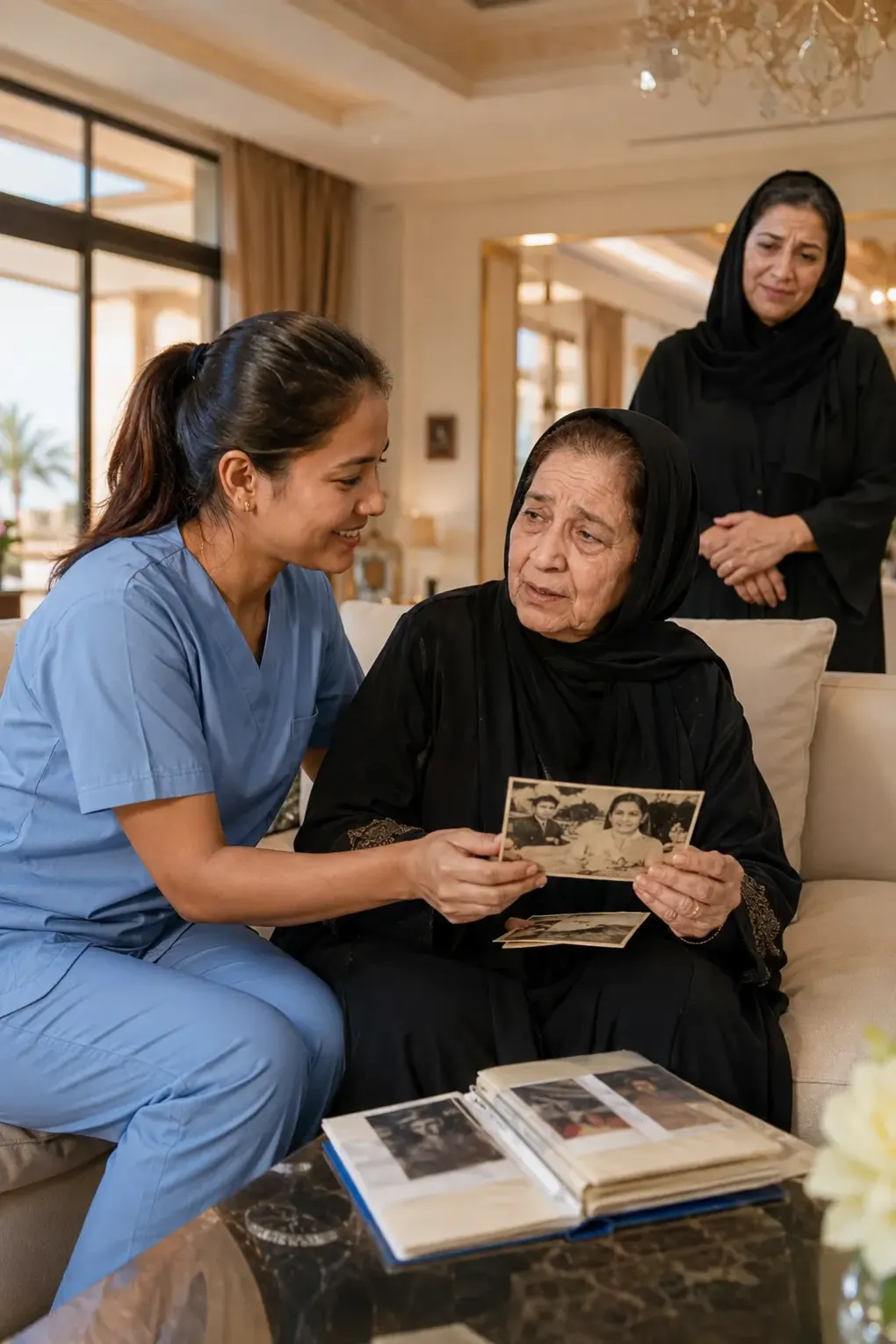
Alzheimer’s does not follow a schedule. Agitation can come at 4pm or 2am. A patient can refuse food for three days, develop a urinary infection that goes unnoticed, or wander toward a door in the few minutes a family member steps away. A trained nurse recognises these patterns before they become emergencies. She builds a daily routine that reduces anxiety, monitors physical health at every visit, manages medications safely, and guides the family through each stage of the disease with honesty and practical support.
Beyond the clinical work, a good nurse changes the atmosphere of Alzheimer’s care at home for the elderly. Families stop bracing for the next difficult moment and start feeling supported through it. That makes them better caregivers in the hours the nurse is not there. It is not a small thing. It is the difference between a household that is surviving the disease and one that is managing it with some grace.

The first thing I do is look at what is happening in the hour before the agitation starts, not during it. Most of the time something is overstimulating the patient well before the behaviour surfaces. A loud television, a busy kitchen, too many people talking at once. I had a patient in Deira, a retired gentleman, whose evenings were becoming very difficult for his family. I visited three days in a row specifically at 4pm to observe. The news was blasting on the TV, grandchildren were doing homework at the same table, and dinner was being cooked right behind him. I asked the family to move him to a quieter room at the same time each day, put on soft music from his era, and have just one person sit with him over a warm drink. Within a week the evenings became manageable. The agitation was not random. It had a trigger. That is always where I start.
I stop immediately, take a small step back, and become very still. My own calm is the first tool I use because tension travels fast in these situations. I lower myself to the patient’s eye level and I wait a moment before saying anything. Then I look for the trigger. It is almost always there. I cared for a patient who would push my hands away firmly every morning during his wash. Over a few days I noticed it happened consistently when I moved too quickly or without warning. I started narrating every single step before I did it. A few soft words, a pause, then the action. Within two weeks the resistance stopped. Aggression in these patients is communication. They are telling me something does not feel right. My job is to find out what.
I answer it the same way each time without any trace of impatience, because for them it genuinely is the first time asking. But I also try to hear what the question is really about. I had a patient who asked ‘when is my husband coming home?’ perhaps forty times one afternoon. After a while I realised she was not looking for a time. She was looking for reassurance that she would not be left alone. I shifted my answer from a time on the clock to something warmer. ‘You are not alone, I am right here with you.’ That settled her far better than any accurate answer would have. I also suggested to the family that they write a short note in her handwriting from a clearer day and stick it on the fridge. She would read it herself and feel reassured. Small things carry a lot of weight.
I never make it a confrontation. The moment it becomes a battle, I have already lost the patient’s cooperation for the rest of the day. I look at the form of the medication first and check with the prescribing doctor whether a tablet can be crushed or whether a liquid form is available. Then I look at the timing. I had a patient who consistently refused her evening tablets but accepted them without any issue when I offered them right after her favourite television programme ended, before her mood shifted for the night. I also changed how I offered them. I stopped announcing it as medicine time. I simply placed them beside her with a small glass of juice and sat with her. Making it feel like a normal part of the moment, rather than a medical procedure, changes a great deal.
I never block the door and say no directly. That creates immediate panic and makes the urge to leave stronger. I walk with them instead. I fall into step beside them and ask, in a relaxed way, where they are heading. There is almost always a purpose behind it, something from their past that feels urgent and real to them. I cared for a patient who tried to leave every afternoon at 3pm because her mind had returned to the years she used to collect her children from school. Her family was distressed each time. I worked with them to create a small ritual at that exact time each day. We would look at photos of her grown children together and have a cup of tea. The door attempts stopped within two weeks. I find the need underneath the behaviour and try to meet it another way.
I never push for a bath when a patient is already unsettled. I use that time to prepare everything instead, so that when the moment is right, nothing creates friction. I warm the bathroom before we go in. I have the towel ready, the water temperature checked, the soap and shampoo within reach. No searching around once we are there. I cared for a patient in Jumeirah who was genuinely frightened of the shower but completely calm with a warm flannel wash. That became her daily routine. On days when she was relaxed and agreeable I would gently suggest a proper shower and she would usually come along. I also learned she hated being fully undressed at once, so I started doing it gradually, one piece at a time, keeping her covered throughout. The pace and the dignity of it matter far more than the method.
I sit with them and eat something myself. That sounds simple but it works consistently. The social habit of sharing a meal runs very deep and it surfaces even when much else has faded. I also stopped presenting full plates. A full plate can feel overwhelming and lead to the whole thing being pushed away. I put out a small amount, and when that is finished I quietly offer a little more. I had a patient in Sharjah who pushed his plate away untouched every lunchtime without fail. His family was worried. I started sitting across from him with my own small plate and we ate together quietly. He began picking up his fork within a few days. I also moved a lot of his meals to finger foods he could manage without cutlery. Small pieces of bread, fruit, cheese. No concentration required, no frustration. He ate much better and the family had one less daily struggle.
I do not introduce a routine all at once. I start with one anchor point, usually the morning, because that sets the tone for the rest of the day. I keep the wake time consistent and the sequence of washing, dressing and breakfast the same each day. Once that feels settled, which can take a week or two, I add an afternoon anchor. Then an evening one. I worked with a family in Business Bay who felt a fixed routine did not suit their household. I told them the patient does not need to know it is a routine. She just needs to stop feeling surprised by what comes next. Once the sequence became predictable her afternoon anxiety reduced noticeably. A brain that can no longer hold new information finds real comfort in knowing, without having to think about it, what happens next.
I handle it efficiently and without drawing attention to it. No sharp reaction, no lengthy explanation. I simply say, let us get you comfortable, and I move. Taking the patient to the bathroom every two hours as a routine prevents most accidents from happening in the first place. I make sure clothing is easy to remove quickly. Elasticated waistbands, nothing complicated. The bathroom path is always clear and lit. I worked with a family who felt tremendous guilt about using absorbent briefs for their father. They felt it was undignified. I said to them, what is actually uncomfortable is wet clothing and the distress that comes with it. This keeps him dry, comfortable and free to carry on with his day. Once they saw it as a comfort measure rather than a loss, the guilt lifted and so did the tension around it.
I always ask the family before my first visit about who this person was before the diagnosis. What did they do with their hands? What were they good at? What gave them pride? The activities that work are always rooted in the person’s identity, not in a generic activity sheet. I cared for a patient in Al Barsha who had been a tailor for most of his working life. He could no longer follow a conversation but when I placed fabric swatches on the table he sorted them by colour and texture for forty minutes without any prompting, completely absorbed. Another patient who had been a keen gardener would spend entire afternoons happily tending to small pots I brought with me. I do not reach for puzzles or colouring books. I look at who they are and I work from there.
I stop relying on words as the main channel and use tone, pace, expression and touch instead. A calm, steady voice matters more than the meaning of the words. I sit at their level, make soft eye contact, use their name, and move slowly. I had a patient who had lost most of her speech and could not process what was said to her, but she responded very clearly to tone. When I arrived rushed or tense she became unsettled within minutes. When I came in quietly and warmly she was cooperative and calm for the whole visit. I also kept narrating my care throughout. Not because she understood each word but because the steady, familiar sound of a voice is itself reassuring. Silence during personal care can feel threatening to someone who cannot make sense of what is happening to them.
I go with them. I do not correct and I do not confirm in a way that creates problems later. I step into the feeling of the moment instead. I cared for a patient in Dubai Marina who spoke about her mother every day as if she were still alive, asking when she would visit. Her family would gently try to remind her each time and each time she was freshly upset. I asked them to try a different approach. When she asked, I would say, tell me about her, what is she like? And she would talk warmly for twenty minutes. No distress, just a happy memory. I helped the family understand that the goal is not factual accuracy. The goal is her wellbeing in that moment. That reframe changed their whole approach to her care, and the daily grief her correction was causing simply stopped.
I sit close and I do not try to fix it straight away. Families often want to reassure with words, to explain that everything is fine. But in that state the patient cannot process the explanation. What they can feel is presence. I sit beside them, I put my hand over theirs, I breathe slowly. I might hum something softly. I do not ask them to stop or tell them there is nothing to worry about. I just stay. I had a patient who became tearful every afternoon around the same time each day. We never found a clear reason for it. But we found that if someone sat close with her during that window it passed much more quickly than if she was left alone with it. Sometimes the most skilled thing a nurse can do is simply not leave
I prepare the family for this before it happens wherever I can. When I see it coming I start having gentle conversations so they are not blindsided when it arrives. I advise them to introduce themselves by name without making it a test. Not ‘do you know who I am?’ but simply ‘Hi Baba, it is Layla, I am here for lunch.’ Low pressure, warm, completely normal. I also remind families that even when the recognition of a name and face is gone, the feeling of safety around a familiar person often stays. I have seen patients who could not name their own children become visibly settled and calm the moment that person walked into the room. I encourage families to stop seeking recognition and start seeking connection. Those are two different things, and the second is still very much possible.
I keep doing exactly what I was doing before, just more quietly. I still use their name. I still narrate my care. I still play the music they loved. I still hold their hand during the visit. I had a patient in her final weeks who had not spoken in over a month. Her daughter asked me whether it was still worth talking to her. I said yes, without any hesitation. Hearing is the last sense to go. Her daughter started reading aloud from a book they had both loved years ago, and whatever was happening for that patient on the inside, she looked peaceful during those readings. The relationship does not end when the conversation does. It continues in a quieter form, and that form still matters.
I raise it directly. I do not wait for them to bring it up because they rarely do. Primary caregivers push through and feel guilty for struggling, as if struggling means they are not doing enough. I check in on the caregiver at every visit, not just the patient. Simple questions. When did you last sleep properly? Have you left the house this week? Is anyone helping you? When someone tells me they have not slept more than four hours in two weeks, that is a concern I take seriously. I work with families to build a shared rotation so no one person is carrying everything. Even two or three mornings a week with a home nurse changes a caregiver’s capacity entirely. I have seen primary caregivers go from barely coping to genuinely present and warm again just from having a small amount of regular support built in. It changes the care the patient receives too.
I ask for a family meeting early in my engagement, before disagreements have had time to solidify into conflict. Most disputes about care come from people having different information, not different values. When everyone is in the same room with the same clinical facts, the conversation shifts. I have also found that the family member who visits least tends to hold the strongest opinions. I address that gently by inviting them to come for a full visit, not a brief call in, to actually be present through a difficult morning or a long evening. Once they have experienced what daily care looks like, opinions tend to become more collaborative. I stay neutral throughout. My role is not to take sides. My role is to keep the focus on what the patient needs, and that is usually a good enough anchor when conversations get heated.
I do it in stages, well ahead of each transition. I never sit a family down and deliver a lot of difficult information at once. When I can see that a patient is moving from one phase to the next I start preparing the family in small conversations spread across several visits. I tell them what I am noticing, what it likely means, and what we will need to adjust in the routine and the care. I keep it practical. What changes, what equipment might help, what to watch for. I had a family who asked me early on to always be honest with them even when it was hard. I respected that and I found it made them much better at making decisions when those decisions became urgent. Families who are prepared handle the hard moments with far more steadiness than those who are not.
I tell them directly that it is normal and I would be more concerned if they said they never felt frustrated. They are caring for someone they love who no longer behaves like the person they love, while managing their own lives and their own grief at the same time. Losing patience sometimes does not make anyone a bad caregiver. It makes them human under sustained pressure. What I suggest is practical. When you feel it building, step out of the room for two minutes. Come back when you are ready. The patient will not carry the memory of that moment. But the caregiver needs to process it so it does not accumulate into something that breaks them. I also encourage every primary caregiver to have at least one person they can speak honestly to, someone they do not have to perform being fine for. That outlet matters more than most people realise.
I raise it myself when I see the signs, because families are often too close to see it clearly or feel too much guilt to say it out loud. What I look for is whether the patient’s safety can be reliably maintained at home even with daily nursing support, whether the physical care needs have grown beyond what the home environment can hold, and whether the primary caregiver’s own health is genuinely deteriorating. When those things come together I have an honest conversation. Not to push toward any particular decision but to make sure the family is making it with clear information rather than fear or guilt. Moving to a memory care facility when the time is right is not abandonment. It is finding the right level of care for where the disease is now. Families who make that move thoughtfully, and who continue to visit and be present, find that the relationship with their parent often becomes calmer and more meaningful once the weight of full-time physical care is shared.
I walk through the entire home on my first visit, room by room, with the family present. I look at it through the patient’s eyes rather than the family’s. Loose rugs that a steady person steps over without thinking become a serious hazard. Poor lighting in the corridor at night. A bathroom with no grab support. A kitchen with accessible gas or unlocked medications. I address these first and I always try to make the changes feel like a natural part of the home rather than clinical additions. A grab rail can be fitted cleanly. A nightlight in the corridor is barely noticeable. A locked cabinet looks like any other cabinet. I also come back to safety each time the patient’s abilities change, because a home that was safe six months ago may have new risks as the disease progresses. It is not a one-time assessment.
I start with the daytime, not the night. Night waking is almost always fed by too much sleep during the day and not enough light and movement in the morning. I work with families to get the patient outside or near a bright window within an hour of waking. Afternoon naps I keep short, thirty minutes and not after 3pm. Real activity in the morning and early afternoon gives the body reason to rest properly at night. Then I look at the bedtime routine. Warm wash, comfortable clothing, dim lighting, no television. I cared for a patient whose night waking was being made much worse by the family turning on all the overhead lights every time he got up confused. We switched to a small nightlight in the corridor and stopped using the main lights at night. He started settling back within ten minutes instead of staying awake for hours. The evening environment matters more than most families expect.
I watch the body closely during movement and personal care. A flicker across the face when I reposition a limb. A hand that moves to guard a spot. A small change in breathing when I touch a particular area. I had a patient whose family believed her episodes of screaming were purely behavioural. Something made me check her mouth carefully at one visit. She had a cracked tooth that had gone unnoticed for weeks. Once it was treated, the episodes stopped entirely. I also pay close attention to any unexplained change in behaviour. Sudden restlessness, withdrawal, new resistance to touch. These are often pain expressing itself without words. Constipation, a developing pressure sore, a urinary infection, a poorly fitted shoe. I check for all of these routinely because they are common and commonly missed.
The priorities shift completely at this stage. It becomes about comfort, skin protection and presence. I reposition the patient every two hours to prevent pressure sores and check the skin carefully at every visit, particularly the heels, tailbone and hips. Mouth care becomes important as eating and drinking reduce because the mouth dries quickly and that discomfort is real even when it cannot be communicated. I use small soft swabs to keep the lips and mouth moist. I do gentle passive movement of the limbs to keep them from stiffening. I keep the room calm and familiar throughout. Same music quietly in the background, same routine, same unhurried pace. I still use the patient’s name. I still talk through what I am doing. Not because I expect a response but because the environment of care we create around a person at this stage is itself a form of treatment.
I begin those conversations early, in small pieces over several visits, not as a single difficult announcement. I tell the family what I am observing. Longer periods of sleep, less interest in food, quieter responses. I explain what those changes mean in plain terms and I give them time to absorb it. I tell them what the final days may look like practically, so they are not frightened by normal changes when they appear. I encourage them to say what they want to say, to play the music their parent loved, to be close and unhurried. I always mention that hearing goes last. So the room should sound the way love sounds in that family, whatever that means to them. I have been present for many peaceful home passings and what I consistently observe is that the families who prepared, who gathered the people that mattered, who were simply there and present, those are the ones who find some steadiness in it afterwards.
These answers reflect Sapna Dahal’s personal nursing experience and are intended for educational guidance only. They do not replace the advice of your physician or neurologist.
© 2026 All rights reserved |