© 2026 All rights reserved |


Clear answers for families arranging home nursing or caregiver support for a parent or spouse living with Parkinson’s disease covering stages, mobility, medication timing, and how to get started safely at home.
Professional Nurses | 24/7 Care | Free Home Assessment | Coverage Across Abu Dhabi
Parkinson’s disease changes day by day, and sometimes hour by hour, requiring a flexible, personalized approach to home nursing care. Supporting someone with Parkinson’s involves navigating its evolving stages, managing tremors, assisting with mobility, and strictly adhering to medication timing, as well as choosing the right level of support, whether hourly visits or 24-hour nursing care.
In home nursing practice, care plans adapt dynamically to these daily fluctuations. Every aspect of support reflects how hands-on care functions in the domestic setting, serving as a practical framework alongside a neurologist’s diagnosis and treatment plan to help coordinate effective care.
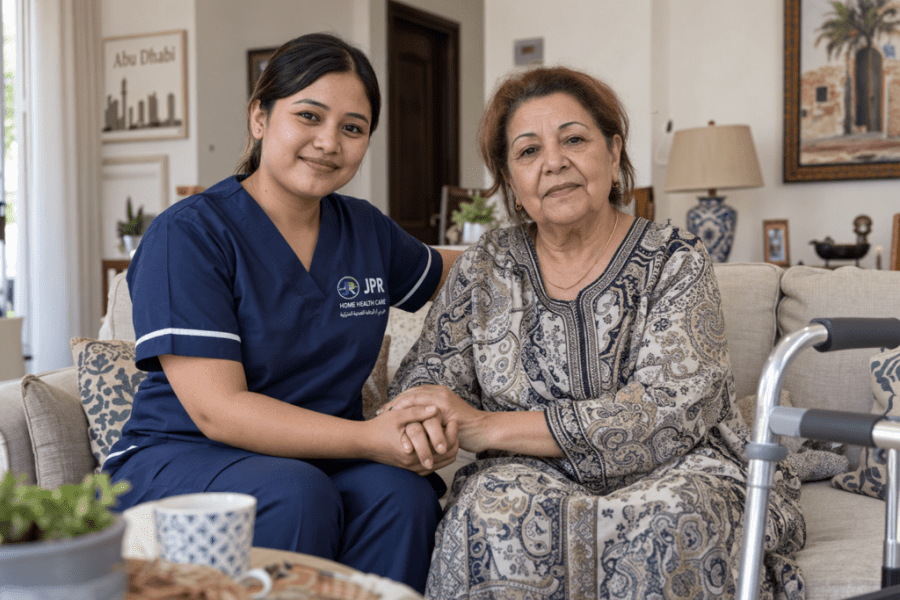
Not sure where to start? A free home assessment tells you exactly what level of care your loved one needs.
Parkinson’s disease is a progressive nervous system disorder that affects movement. It develops when nerve cells that produce dopamine, a chemical that helps coordinate movement, gradually break down.
Over time this leads to tremors, stiffness, slowed movement, and balance difficulties, with symptoms and their severity varying quite a lot from person to person.
Early signs often include a slight tremor in a hand or finger, smaller or slower handwriting, stiffness or reduced arm swing on one side, a softer voice, and a face that shows less expression than before.
These changes are usually gradual and easy to dismiss at first, which is why a diagnosis often only comes after a family member notices a pattern over several months.
Most people with Parkinson’s, from early diagnosis through advanced stages, can be supported safely at home in Abu Dhabi. A licensed home care nurse or trained caregiver manages medication timing, mobility support, and daily routine.
Hospital care is generally reserved for medical crises or surgical procedures rather than day-to-day management. See our general guide to elderly care in Abu Dhabi for a broader overview of home-based options.
Parkinson’s is often described across five stages, from mild one-sided symptoms to advanced disease with significant mobility loss. Early stages usually need light supervision and medication reminders.
Middle stages add mobility and fall-prevention support, and advanced stages typically require full assistance with transfers, feeding, and skilled nursing care as independence decreases.
A home care nurse manages medication timing precisely, since Parkinson’s drugs work on a strict schedule, monitors mobility and fall risk, and assists with exercises that maintain flexibility.
They also track changes in symptoms to report to the treating neurologist, similar to the structured tracking described in home-based monitoring for elderly care in Abu Dhabi.
A caregiver supports daily activities such as bathing, dressing, meals, and mobility assistance, while a licensed nurse additionally manages clinical tasks including precise medication administration and monitoring for complications.
Many families combine both roles as the condition progresses. Read the full comparison in choosing between a caregiver and a nurse.
Cost depends on the stage of the condition and whether care is arranged as hourly visits, a live-in arrangement, or full-time skilled nursing.
Rather than quote a figure that may not reflect your loved one’s actual needs, a free home assessment gives an accurate, written quote based on the real level of support required.
Early-stage Parkinson’s often needs only a few hours of daily support for medication reminders and light mobility help.
Middle and advanced stages, especially with fall risk, freezing episodes, or significant medication fluctuations, usually benefit from 24-hour live-in or shift-based nursing for continuous safety.
Caregivers support gentle stretching and movement routines, assist with tasks that tremors make difficult such as eating or buttoning clothing, and time activities around medication windows, when movement is typically smoother.
Caregivers watch for freezing episodes and shuffling gait, assist with safe transfers between bed, chair, and bathroom, and help clear walking paths of hazards.
Structured, supervised movement significantly reduces the high fall risk associated with Parkinson’s balance changes. See more in reducing fall risk in elderly patients at home.
Parkinson’s medications, particularly levodopa, need to be given at consistent times to avoid “on-off” fluctuations between good and poor symptom control.
A home nurse tracks exact dosing times, watches for wearing-off symptoms between doses, and reports patterns to the neurologist so the schedule can be fine-tuned.
As Parkinson’s progresses, slower chewing, drooling, and swallowing difficulties become more common, raising the risk of choking or aspiration.
Caregivers offer smaller portions, texture-modified food when needed, and unhurried mealtimes, with a nurse monitoring for signs of swallowing trouble — the same vigilance described in how nurses help prevent aspiration pneumonia at home.
Parkinson’s can soften and slow speech over time. Caregivers are trained to be patient, allow extra time to respond, and ask one question at a time.
Encouraging the person to speak slightly louder or slower, rather than finishing sentences for them, helps preserve both communication and confidence.
Recommended changes include removing loose rugs and clutter, adding grab rails near the bed, bathroom, and stairs, using non-slip mats, and ensuring clear, wide walkways.
A stable chair with armrests makes sitting and standing considerably easier. For safe movement between rooms and transport, see safe transfer techniques in elderly care.
Caregivers allow extra time for each task since Parkinson’s slows movement, and use adaptive techniques such as seated dressing and slip-on clothing where helpful.
Timing these activities around medication, for when the person moves most easily, makes a noticeable difference — related to the broader mobility challenges covered in understanding mobility issues in elderly care.
Respite care is short-term professional cover, whether for a few hours, an overnight, or longer, that gives a family caregiver a genuine break.
It reduces caregiver fatigue and ensures continuous, safe support for the person with Parkinson’s during that time, which matters over what is often a long-term condition.
Depression and anxiety are common in Parkinson’s and are not simply emotional reactions to the diagnosis; they can be part of the condition itself. Caregivers maintain a steady daily routine and encourage social interaction and light activity.
This is why routine matters so much for senior mental health, and why ongoing companionship, as covered in how a home nurse eases isolation, is built into the daily care plan rather than treated as separate from it.
Yes. Home care nurses guide families on medication timing, safe transfer techniques, and fall prevention, along with the warning signs that need medical attention.
This keeps care consistent whether the nurse or a family member is present, and gives families more confidence handling day-to-day fluctuations.
Hospital care is generally needed for medication adjustment under close monitoring, surgical procedures such as deep brain stimulation, or acute complications like severe swallowing failure or a serious fall.
Prolonged immobility around a hospital stay also raises the risk of complications such as those described in preventing bed sores in home care, which is one reason most day-to-day management continues at home before and after these episodes.
Coverage varies by insurance provider and policy, and home nursing benefits are not automatically included in every plan.
It is worth checking your policy directly and asking a home care provider to help confirm documentation requirements alongside private-pay options.
A home care nurse should be licensed to practise in the UAE, and caregivers should have specific training in Parkinson’s-related mobility support, fall prevention, and medication-timing awareness.
Generic elderly care training alone does not cover these disease-specific needs, so it is reasonable to ask a provider directly about condition-specific training.
Essential tremor typically affects the hands during movement or activity and does not usually involve the stiffness, slowness, or balance problems seen in Parkinson’s.
Parkinson’s tremor commonly appears at rest and is one part of a broader set of movement changes, which is why an accurate diagnosis from a neurologist matters before a care plan is built.
A home care nurse is trained to recognise emergency signs such as a fall with injury, choking during meals, or a sudden, severe worsening of symptoms.
The response includes immediate first aid, contacting emergency services when required, and notifying the family and treating physician right away, with a clear record for follow-up.
A home assessment and a matched nurse or caregiver can typically be arranged within a short timeframe of first contact, with urgent situations prioritised.
Reaching out before a crisis usually allows a better match to the person’s specific needs and routine.
Confirm the nurses are licensed and specifically trained in Parkinson’s or movement-disorder care, ask how medication timing is tracked, and check availability for both hourly and 24-hour options.
Insist on a home assessment so the care plan reflects the person’s actual stage rather than a standard package.
Speak with our clinical team about a care plan for your loved one — no obligation, just clarity.
Follow overview of JPR’s home nursing service
General senior home care services
Follow overview of Blood Test at home service
Follow overview of Physiotherapy at home service
Follow overview of Baby Care service
Follow overview of JPR’s home nursing service
This page is provided for general information and is not a substitute for a medical diagnosis or professional care plan. Please consult a qualified physician for diagnosis and treatment decisions, and speak with JPR’s clinical team to arrange an assessment suited to your loved one’s specific condition.
© 2026 All rights reserved |