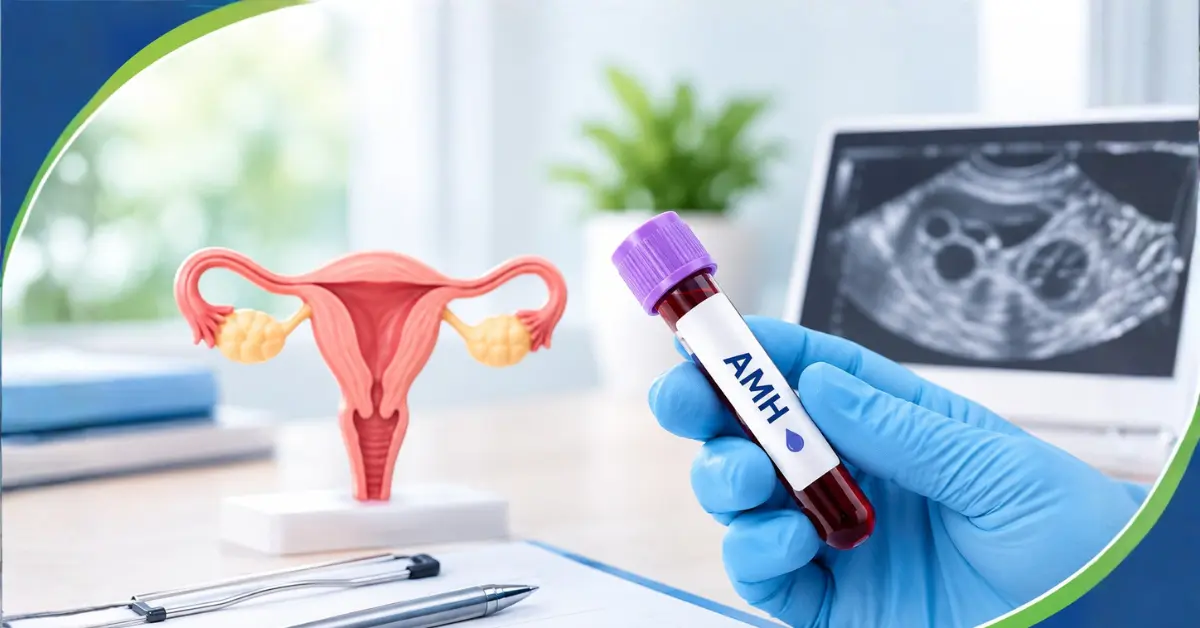
When people hear the words “ovarian reserve,” it is easy to assume that a single number can tell them how fertile they are. This is where the AMH blood test often gets misunderstood.
AMH, or Anti-Müllerian Hormone, is a hormone produced by cells in small ovarian follicles. Measuring AMH can provide useful information about the number of follicles remaining in the ovaries. But it does not give a complete picture of fertility.
Think of AMH as one piece of a much bigger puzzle. It can offer useful clues, particularly when fertility treatment is being considered, but it cannot tell the entire story of someone’s reproductive future.
What Exactly Is AMH?
AMH stands for Anti-Müllerian Hormone. Certain small follicles in the ovaries produce it. The level of AMH in the blood is associated with the number of these developing follicles. In general, AMH levels tend to decrease as the number of ovarian follicles declines with age. This is why doctors may use an AMH blood test when assessing ovarian reserve. Unlike some reproductive hormones, AMH can generally be measured at different points during the menstrual cycle. This makes the test relatively convenient compared with hormone tests that need to be performed during a particular phase of the cycle. But there is an important distinction: Ovarian reserve is not the same thing as fertility. Ovarian reserve mainly refers to the quantity of eggs remaining. Fertility involves much more, including age, ovulation, the reproductive tract, sperm factors, egg quality, embryo development, and other individual factors.
What Can an AMH Blood Test Tell You?
The most useful role of AMH is helping provide information about ovarian reserve.A relatively higher AMH level generally indicates a greater number of small ovarian follicles, while a lower level can be associated with a smaller ovarian follicle pool.Doctors may use AMH alongside other information when planning fertility treatment, particularly IVF. AMH can help predict how the ovaries may respond to medications used to stimulate the ovaries and can help estimate the likely number of eggs that may be retrieved.This is one of the most practical uses of the test. For example, if someone is preparing for IVF, knowing their AMH level may help the fertility team think about how the ovaries could respond to stimulation.
However, an AMH result should not be viewed in isolation. Age, medical history, ultrasound findings, previous treatment response, and other factors can all influence how the result is interpreted.
What Can’t an AMH Test Tell You?
This is where many misunderstandings begin.
An AMH result cannot tell you exactly how easily you will become pregnant naturally.
Research reviewed by ASRM found that ovarian reserve markers are poor independent predictors of reproductive potential. In other words, a low AMH result does not automatically mean that pregnancy is impossible, just as a higher AMH result does not guarantee pregnancy. AMH also does not directly measure egg quality. This matters because the number of eggs and the quality of those eggs are different concepts. Ovarian reserve testing primarily provides information about quantity, while reproductive success depends on several other biological factors.
So, an AMH result should never be treated as a simple “fertility score.”
Can a Low AMH Mean You Cannot Get Pregnant?
Not necessarily.
A low AMH may indicate diminished ovarian reserve, but it does not mean that pregnancy is impossible.
This distinction is particularly important because an alarming interpretation of one laboratory number can create unnecessary fear.
ASRM notes that ovarian reserve testing should be interpreted alongside the individual’s age, medical history, and other clinical information. A diminished ovarian reserve result does not necessarily mean a person is unable to conceive. This is why your doctor may recommend additional evaluation instead of making conclusions based on AMH alone.
What About a High AMH Level?
A higher AMH level is not automatically “better.”
AMH is associated with the number of small follicles, so higher levels can occur when there are more small follicles. Certain ovarian conditions can also be associated with higher AMH levels. Therefore, a high result needs context too. The goal is not simply to chase a high number. The useful question is: “What does this result mean in my particular situation?” That question is much more valuable than asking whether a number is good or bad.
AMH and Age: Why Both Matter
Age remains an important factor when discussing reproductive potential.
Ovarian reserve generally declines with age, but people of the same age can have very different ovarian reserve measurements. This is one reason AMH can provide additional information rather than simply relying on age alone.
At the same time, AMH does not replace age when assessing reproductive potential.
This is a crucial point for anyone researching fertility online: AMH is a marker of ovarian reserve, not a crystal ball for pregnancy.
Is AMH the Only Ovarian Reserve Test?
No.
Healthcare professionals may consider AMH alongside other assessments.
One commonly used method is the antral follicle count (AFC). This is performed using ultrasound to count small follicles in the ovaries.
Other reproductive hormone measurements may also be considered depending on the person’s circumstances.
ASRM identifies AMH and AFC as sensitive measures of ovarian reserve, while emphasizing that ovarian reserve tests have limitations when used to predict reproductive potential.
Sometimes these tests may broadly point in the same direction. In other situations, results can differ. That is another reason interpretation should be based on the complete clinical picture rather than one number.
Does the AMH Test Need to Be Done on a Specific Day?
One convenient feature of AMH testing is that it can generally be measured at different points during the menstrual cycle. However, there are circumstances that can affect interpretation. For example, ASRM notes that hormonal contraceptive use may be associated with lower AMH levels, so the result should be interpreted with that information in mind. Your healthcare provider or laboratory can advise you about any preparation requirements based on the test being performed and your medical history. For people looking for convenient testing options, a blood check at home in Dubai may be available through selected healthcare providers, depending on the service and test requirements.
When Might an AMH Test Be Useful?
An AMH test may be considered when a doctor is evaluating ovarian reserve or planning fertility treatment. It can be particularly useful when a fertility specialist wants to estimate how the ovaries might respond to stimulation during treatments such as IVF. It may also form part of a broader fertility assessment when there are concerns about ovarian function. However, testing is not necessarily useful for everyone simply because they want to know their fertility status. ASRM specifically notes that ovarian reserve tests should not be treated as general fertility tests in people without infertility.
The Most Important Number May Not Be the One on Your Report
Seeing an AMH result can naturally trigger questions:
“Is my level normal?”
“Can I still get pregnant?”
“Should I freeze my eggs?”
“Does this mean I have fertility problems?”
But the number alone cannot answer all of these questions.
A better approach is to look at the AMH result as one data point in a larger picture.
Your age, menstrual history, medical background, ultrasound findings, fertility goals, and, where relevant, your partner’s fertility assessment may all contribute to a meaningful evaluation.
The Bottom Line
The AMH blood test can provide valuable information about ovarian reserve, particularly when doctors are planning or assessing fertility treatment.
But it has limits.
It does not directly measure egg quality, and a low or high result does not by itself determine whether someone will or will not become pregnant. Current evidence supports using AMH as part of a broader clinical assessment rather than treating it as a standalone fertility prediction tool.
So, instead of asking, “Is my AMH good or bad?”, a more useful question is:
“What does my AMH result mean when considered alongside my age, health and reproductive goals?”
That is where the real value of the test begins.
This article is intended for general informational and educational purposes only. It is not a substitute for professional medical advice, diagnosis, or treatment. If you have concerns about your health or test results, please consult your doctor or a qualified healthcare provider.